Thursday, December 8, 2011

Thanks for a great semester :)

   Well it is the final blog post, which naturally means it is the end of another semester.  

       When first starting off the semester in this Rhetoric of Literature class, I was not exactly sure I would survive. The readings in our rhetoric book started off rather difficult, with the quizzes following and proving to be just as difficult. I could not tell you the difference between a Sophist and a Naturalist, and I probably couldn’t even have given a definition for rhetoric. At the very least, I have learned how to properly read and process difficult information this semester. When reading pieces from books like our rhetoric text book, it is not possible to fully understand the information by skimming the passage. This is something I remember Dr. Morris explaining to our class on one of the first days of class after many of my classmates failed the first reading quiz. This reading skill is one I hope to take on with me to future english class which will certainly involve some heavy reading.

When it comes to rhetoric, I have learned a great deal more than I ever imagined. For one, I can actually define the word now. I know this class focused mainly on the use of rhetoric in environmental texts, however what I took away most from this class is how to be a better public speaker. Some of my favorite authors from the book: Cicero, Burke,  and Kierkegaard, all taught me how to reach out to the proper audience, and publicly share my thoughts and opinions with anyone I may be speaking to. Public speaking is something I always have and always will enjoy and I hope that I will be able to apply my new found rhetorical skills, and persuade others to listen to my “truth”. I also enjoyed the  showing of Wall-E in class. After focusing on texts and literature all semester, it was a good opportunity to see rhetoric used in a different form of media.

       The only negative aspect of the course I found were the daily reading quizzes. I understand Dr. Morris’s reasoning behind giving the quizzes, and making sure every one in class read, however, I read for every class and still did not do as well as I would have liked to on the reading quizzes. Most of the time, especially with the rhetoric book, it was a lot of information to digest at once which is what tended to overwhelm me when taking the quizzes. Just as a suggestion for the future, maybe it would be possible to still have reading quizzes, but structure them in a different way. Instead of having set questions, maybe just ask students to write down five main ideas they got from reading a passage. This would also help Dr. Morris to see what students were obtaining from the readings, as well as what they were interested in most.

       Overall, I enjoyed this Rhetoric of Literature a lot more than  I anticipated at the beginning of the semester. I was able to learn how to better my use of rhetoric in speaking, writing, and other media, while also learning about our environment. This will probably end up being one of the more useful classes I take in my years as an undergraduate student. I intend to take what I have learned here and carry it with me throughout the rest of my career as a student, and hopefully one day as a teacher in my own classroom.

I love speaking.

I love speaking. public speaking. conversational speaking. whatever.


...and is it weird that ever since taking this class, I find myself unintentionally using rhetoric and the skills we've learned ALL THE TIME when I speak? Anytime I'm trying to persuade someone to do something or go somewhere, or agree with what I'm saying. . . BOOM RHETORICAL SKILLS!

Yesterday for example, I was talking to some of my girls on my floor in Deatrick, trying to convince them to live here again. I gave them all the pros and cons. . . Kierkagaard would have been disappointed though. He's all about "practicing what you preach" and whatnot. Here I am, trying to convince these girls that Deatrick is the place to live again, when I myself am not even living here next year. I'm so over dorm life and want my own apartment. Ooooops, sorry Kierkagaard.

I also find that I am a lot like a TV advertisement. When I speak, or when Im' trying to persuade someone to something, I only give them the positives of the situation. Never the negatives. I definitely do it intentionally. Who wants to share the bad, when you're so focused on the good. I kind of remind myself of those videos we watched in class one day. The first was about the natural, home grown-type farm, and the second was about the company that chemically engineers corn. I am totally that commercial. I also talk about the positives and great things of whatever I'm trying to push for, but hide, or "sugar coat" the negative effects. I'm not really proud of this trait. I think I talked about in an earlier post how a "good" orator should be able to still convince his audience he is right even after presenting both sides of an argument.


Future career in advertising?

"...but good luck anyway."

I spoke with a housing administrator (who shall remain nameless by choice) yesterday about my Operation Deatrick project. After hearing my proposal, and everything I wanted to do, she said, "We've tried for years to get students interested in recycling. It never works, so don't be disappointed if you don't get the results you're looking for... but good luck anway".

What a crap attitude.

I understand that it is hard to get colleges students motivated about their own school work, let alone recycling. Does that mean you give up and chalk it up to students not caring?

No, most students don't know we have recycling bins.

No, most students wouldn't use them if they knew we had them.

No, most students aren't concerned with saving the environment.

But that CAN change. I don't care what anyone says, I know it can change. At the beginning of this semester, (pardon my french), but I could have given two shits about recycling. I could have cared less about conservation or the environment, or any of that stuff. I was "that girl" who threw trash out of her car window while driving, who noticed recycling bins, but probably never put anything into them.

And here I am now. 3 months later, organizing a program for my entire dorm to get people excited about recycling. To get people excited about saving the earth. To get people to STOP throwing trash out of their car windows ;)

Maybe housing officials didn't take the right steps, or maybe then gave up too soon. My hope is that students will see this coming from me (a fellow student), and will be able to relate better with what I have to say. I don't expect to change the world, but if I can change the minds of even a couple of students, I will be satisfied.

Rhetoric in film.

I must say, I've really enjoyed watching Wall-E in class this past week. I know I posted about it earlier, but I have a different point this time.

All semester, we've been reading and reading and reaaaaaaaaaading different pieces of literature, different works from different authors. That's all find and dandy, but it's kind of nice to have a break from reading.

My point here is, I really enjoy getting to pick rhetorical strategies out of a different kind of media, because I never really realized these strategies are used in literally every aspect of our society. I did enjoy picking through books and articles in our American Earth text. It was neat to learn about the Sophists, the Naturalists, Existentialism, and everything else we discussed from our rhetoric text, however, it's even cool to be able to see those same strategies at play in something that is aimed at a more modern public...especially something that is aimed primarily at children.

Thankfully, in Wall-e, the director used rhetoric to get a positive message across to children, one that will hopefully impact the way they grow, live, and respect the environment. However, all too often in today's movie industry we see negative and inappropriate messages being portrayed to our children. It seems like everything is about sex, drugs, alcohol, smoking, or being skinny. This is were we run into the problem. Rhetoric is SUCH a powerful tool if used correctly, that it makes me nervous for the children of today.

It is a pleasure to for once see a director using these skills for persuade students in the more positive direction of recycling, getting exercise, taking care of our planet. It would be nice to see more movies today hold such an important message.

NORESCO :)

The company I have gotten involved with for my "Go Green!" Program in Deatrick Hall is called NORESCO. I first learned of the company back in August, as they were recruited by Kutztown University before to give a presentation on energy conservation and recycling to all community assistants at our summer training. NORESCO has also worked with Millersville University, The University of Rhode Island, as well as many public high schools in Virginia and South Carolina.

The main goal of NORESCO is to focus in on energy conservation and recycling problems in school facilities, and residence halls. They promote things such as taking shorter showers, turning the lights, not leaving fans or televisions on, and most importantly...recycling.

Since the problem I have found in Deatrick Hall deals with the behaviors and mind sets of students, I was immediately attracted to NORESCO's "Behavior Change Program" which focuses on dealing with current situations using the resources available in that area. The statement I found on their website reads as follows:

"Our proprietary Sustainable Behavior Change program utilizes a cognitive-social-based process that promotes cultural change. Our process measures multiple motivational factors, behaviors, and perceptions of energy use among members of the focal community. Assessing these factors allows NORESCO to custom-tailor a behavioral change program for each client, making full use of existing mechanisms.

Energy Conservation Through Behavior Change® is a dynamic program, and therefore is modified before each subsequent implementation using pre-post intervention assessment findings. In this way, specific components of the process can be modified, added or deleted based on current situational needs. This allows us to continually improve the effectiveness of the program and to accommodate changes in technology, energy costs, and behavior."


When I attended the presentation during the summer, it was clear that NORESCO representatives are passionate about what they do, and truly believe changes can be made (and successful) anywhere, which is why I was so drawn to the company.

If you would like to do any further reading about NORESCO, here is the website :)

http://www.noresco.com/site/content/index.asp

Change of Focus.

So my mind set when I began my final project and now that I have ended my final project has changed a great deal. Initially, I found myself throwing the blame on the Housing and Residential Life Services Office, or the Environmental Office on campus. And while those two departments still have a lot of work to do in making our dorms more environmental friendly, I can't say the blame should be dumped entirely on them.

The more I looked around Deatrick, talked to students and staff, the more I realized the blame lies with in the people this is effecting most--the residents of Deatrick Hall. Most students living in the dorm could care less about recycling. I went around to many of the girls on my floor and 24 out of 60 of them had no idea we even had a recycling bin in the hall. It's not that the resources aren't there, it's just that they aren't being used properly.

Sure, we could still use a few more recycling bins to make our efforts more noticeable, but all in all, I ended up needing to switch to focus of my project. Initially, it was all about getting the housing department to step up and be a better promoter for recycling. However, now that I see that they are already doing this, my project has focused to the students.

Being a community assistant in Deatrick, I am lucky enough to be in a position where I have a lot of influence over the students, which I think makes this project a bit easier. I am now working on organizing a program/presentation for January when we all come back from break to address the recycling issue in Deatrick. I have teamed up with an environmental company, NORESCO (which I will talk more about in my presentation) and have been in touch with some of their specialists in order to create a more effective program.

While the logistics and details of the program are still early on in development, my hope is that after attending my program, students of Deatrick will begin to care a little more about the dorm they are living in, as well as the impact they can have on our earth.

Monday, December 5, 2011

"The earth doesn't need us. . ."

      I love Wall-e to death. I think he is the cutest robot in the world. HOWEVER, watching this movie in class genuinely started to freak me out.


      From talking in class, and by simply being a member of society, we all know that the way our earth is being treated is not positive. We know that as people in today's world, we take advantage of everything we have and everything that is provided to us by the earth. I thought I had an understanding of this, until I started watching Wall-e. Obviously, our world is not at such an extreme point as in the movie, but it is showing us right where we are headed.

      You don't realize just how bad things are, until you step back and take a second to take a look at the direction in which we are moving.


       I think the part that scares me so much about this movie is seeing how truly brainwashed humans get; how sucked into consumerism and materialist we become. While in present day it is no where near to how it is presented in the movie, it is easy to see the future of our world within this film. 

      I would like to believe that humans are smart then that. That humans are able to pull themselves away from our material possessions and focus a little more on the natural world around us. I know we have talked about this a billion times in class, but if people continue this downward spiral of littering, not recycling, and not caring, we are in for a world of trouble. 

      I believe it was Amber who in class said, "The earth doesn't NEED us...we NEED the earth". I don't think this could have been said any better. Without the earth, and without nature, we're destined years from now to end up in a world like the one portrayed in Wall-e.

A good orator.

      Coming into this class at the beginning of the semester, if you said the word "rhetoric" to me, I would have NOT A CLUE what the definition of that word was. This is probably bad, considering I am a junior english education major. However, I guess the point of this post is to let you know that I this is the first time in a while where I have actually learned something, which I have now begun applying it to my life outside of class.
    
      Because I never really knew what rhetoric was, I never really know that is something which is used in the real world literally everywhere we go. You can see rhetoric on television, in advertisements, on the internet, in magazines, in public speeches. . .literally, everywhere.

      As I began working on my final project for this class, I noticed something about the way I was using rhetoric. First off, I am presenting on the residence halls at Kutztown University (specifically Deatrick Hall) and the little amount of recycling that takes place. Yesterday, I ran around the dorm for a half hour or so taking pictures of everything I saw which related to my topic in some way or form. I immediately noticed that I was a first snapping pictures of only the things that supported my argument: plastic bottles in the trash, or laying on the floors, card board spread all over the hallway, etc. I was snapping pictures only of MY "side of the story". I wasn't taking pictures of the areas in which Deatrick Hall excels, such as recycling signs hanging on the walls.

      Society as a whole does this, and does this very well. Advertisements, for example, do exactly what I was doing. In order to get you to buy into the product, they present you with only it's pros...never the cons.

      I guess what I'm trying to get at, and what I got from all of this is that if you're going to present an argument, present BOTH sides of the story. State or show what you believe is true, while also presenting the opposite side. To me, a good orator is able to still convince his audience that he is correct, even with the opposing opinions fully presented.

     Just a random thought which I am going to try to include in my project :)

Tuesday, November 29, 2011

Deatrick Hall: Putting things into perspective.

I open my door and look down the hallway of the fifth floor.
It's Sunday night and the custodians haven't been in since Friday. 
The smell of leftover pizza and beer fills the air.
Cans, boxes, crust, french fries, tissues, paper plates.
A girl coming out of room 500 adds to the pile with another pizza box.
There is trash every where.
It is hard to walk down the main hallway because of the stench from the SEVEN trash cans lining the wall.
Unless you can hold your breathe for a while.
The littering inside this building is just as bad as how people litter outside.
Tampons in the shower. Disgusting.
The two TINY recycling bins we have are basically pointless. No one uses them.
The bathroom trash bin is over flowing also.
If you walk outside, another trash cans and cigarette butts everywhere.
       I feel like living inside Deatrick Hall, or perhaps any dorm for that matter, is like a symbol of our earth, but on a smaller scale. Students living here do not pay any mind to how much they litter, or let the trash build up. They don’t care about recycling. They don’t care if they are literally LIVING in a mess of garbage.  It seems that this is what is happening to our earth as well. People throw stuff wherever they feel is convenient. Recycling is put on the back burner, and before we know it. . .our entire planet will be nothing but trash and garbage, and just like in Deatrick Hall...we will be forced to live in it. 

Better Late than never.

I meant to post this a while, it is my nature experiment. I really did like it, and enjoyed what I wrote. So, here it is:


         I hate bugs. I hate dirt. I hate itchy plants. I hate being too cold or too hot and I hate rain. I would not go as far as saying I hate nature, but I certainly dislike a lot of the things that come along with it. Initially, I thought Emerson was crazy. “Man cannot be happy and strong until he lives with nature in the present, above time”. I could think of plenty of moments in my life when I was genuinely happy that did not involve a rustic kind of nature. For example, I am always happy when I play piano, or sing. I am happy when I read a good book. I am happy when I am spending time with my friends or family. I am happy when the attractive boy in my dorm acknowledges my presence, and I certainly know I am happy when I buy a new pair of shoes. 
-Mom Knows Best-
“Your happiness shouldn’t be dependent on anyone or anything, Kaleigh” my mom nagged through the other end of the phone line.
Mom really does know best. I had heard different variations of that saying before, but never really took it to heart. For as long as I can remember, my happiness had always depended on other people: parents, friends, or boyfriends. If I disappointed them, or was not good enough for them, then I was not happy. The more I thought about what my mom said, the more I realized that maybe I did not really know what true, genuine happiness was; maybe I had not felt that in a long time; maybe I had never felt it at all. That was a scary thought. 
-Rainy Days and Rain Boots-
                                        pastedGraphic.pdf
As I drove out to French Creek State Park on that rainy Monday evening with my rain boots in the passenger seat and bad attitude, I thought more about this idea of personal happiness versus nature. I was certain that I was going to be cold, wet, miserable and alone when I ventured off into nature. Where is the happiness in that? I pulled into the parking lot, and naturally on a rainy Labor Day, was the only person there. Tucking my jeans into my rain boots, I found the nearest clearing and entered into the miles of trees which stood in front of me. At that moment, I decided I may as well make the most of this.
-Nature vs. Happiness-
Walking out of the same wooded area two hours later, I still hated bugs. I still hated dirt, and also mud. I still hated itchy plants. I hated being too cold, and I hated the rain. I did not however, think Emerson was crazy anymore. Sitting in my car still soaked with rain water, I looked over the notes I had taken while in the woods, and began thinking about the task thrown at our class, “Explain how and why happiness can be found and felt by experiencing nature and solitude”. I have come to my own conclusion that one’s happiness being directly related to nature all depends on the person. For some, happiness may come directly from seeing a beautiful flower, or having the fresh breeze blow through one’s hair, or rolling around in the dirt. For myself, I found that my happiness came more from being completely secluded from the human population and technology, not necessarily  from being with the trees and the bugs. During those two hours, I was able to reflect on my life, and emotions and thoughts I had been dealing with in a private setting. It was just me, myself, and I There were no distractions from cell phones, or friends, or parents, or teachers, or the internet. As I though more about this concept of being alone, I finally understood what my mom was trying to convey to me on the phone. It was not necessarily nature that made me happy, it was the realizations I was able to come to when spending time in solitude.

Tuesday, November 8, 2011

Well when you put it that way. . .

So before I say this, I just want everyone to know, I do like nature. I love our earth, I think it's beautiful and I do care about it a lot. I want it to stay beautiful, and I want the people of the world to respect this place that we were give.

HOWEVER, I REALLY can't stand hard core environmentalists. The ones who eat, sleep, and breathe nature. You know the kind of person I'm talking about. For some reason, that "type" of person turns me away from saving our earth because they are so persistent rather then making me want to make a difference. It is possible to make a person such as myself want to save the environment without being so pushy, and I feel like Everything Is a Human Being by Alice Walker, is the PERFECT way to persuade a person to care more about the earth.

The way walker writes, is beautiful. Focusing on the first half of her piece, I can can tell she is trying to persuade her readers to care more, and look at nature as more than just a log with a few leaves attached to it. She wants us to look at snakes as more than just a green slimy, object. She is writing about certain situations to sort of "hit home" with us. Talking about the HOME of the snake--making him seem more like a human being, more relatable. We certainly would never drive to drive a human being out of his home over and over again, day after day.

More specifically, I really enjoy the very beginning of this piece when she talks about the trees.

"I love the trees", I said.
"Human, please, they replied".
"You butcher us, you burn us, you grow us only to destroy us."
"But I, as an individual, am innocent, I said." (661)

How typical of humans is this? Never willing to take the blame for anything. Of course we are innocent. This part kind of makes me angry because the trees have a point! None of us are completely innocent of hurting, destroying, and using nature. Even the strongest of environmentalists use wooden desks, or sleep on wooden bed frames. Reading this section also made me a little sad, the way Walker uses personification to get through to her readers seems to be really effective. It woke me up a little bit, and I feel, has helped me view nature in a different light.

Overall, the way Walker writes, and the stories and examples she uses are so much more effective and so much more useful to me as a reader than any article or documentary I could watch on saving the environment or conservation. By making nature more "relatable", and familiar, she really gets her point across.

Tuesday, November 1, 2011

Saving the world vs. Saving a woman's right.

After discussing the issue of over population in class a few weeks ago, and reading the article,"7 Billion People Fuel Concern over World Resources," I feel like I had seven billion opinions and ideas floating around in my head. So excuse me if this blog is a little scatterbrained. 


I do understand that if the population continues to grow as it has been, the consequences for our world could be detrimental. At some point, we have got to run out of space and food for every one living on the earth. However, while I do know the trouble it could cause, I'm not exactly sure I agree with some of the solutions that my peers have offered up in class. In fact, I definitely do not agree with the idea of taking a woman's right to have children away from her. One or two children seemed to be the "limit" many students suggested, which just blows my mind. Reproduction is something that all humans are born and created to do. Thats just the way our bodies work. I am one of three girls and while people were talking of limiting family size, I could only think about if this was a legitimate law and I didn't have one of my sisters in my life today because of such a law. 


I believe it was Amber who commented on the families like the Duggers from the well known television show, 17 Kids and Counting. In my mind, families of that size are COMPLETELY absurd. I don't see the need for that many children. However, I suppose any of the kids in that family could make the same argument I make about my smaller family. 


Also, if the government were to put a limit on how many children families were allowed to have, this would also create an increase in the abortion rate. You can't physically stop women from getting pregnant.  


I'm not sure how to go about solving the population problem all together because I do not agree with limiting family size, however, I do believe strongly in adoption. There are millions of children all over the world who are just waiting to be taken home by a nice set of parents. I feel as though it is WAY too expensive to adopt children, and if it were a little more affordable, perhaps that right there would solve a portion of the population issue. Lets find all the children that are here already families to go to, before we worry about having our own children. That way, parents are still able to build families of virtually any size they want, but we would also be keeping the population stagnant. 


Relating this to the article we read for today, we also have to keep in mind, certain countries of the world such as Nigeria (where the article takes place) have little to no education on teen pregnancy or contraceptives. I'm going to take a leap and assume that the teen girl the article talks about in the beginning had almost no idea the consequences of having unprotected sex at her age, or what she was in store for. I feel as though if we are THAT worried about over population, more developed countries such as the United States, or countries in Europe should step up and try to inform and educate less developed countries. It would be quite the task, but at this point, anything we do in attempts to slow down population growth is going to be a difficult process.

Wednesday, October 12, 2011

A new found appreciation.

I re-did my nature experiment.

Just because I felt like it. I guess it wasn't even that I re-did it, I didn't take a notebook with me, or worry about being graded, or about presenting my findings in a creative way. I just felt like going out into nature a few days ago when I was bored. If you know me at all, I don't EVER just "feel like going out into nature". Yeah, I have no idea what got into me...but I went.

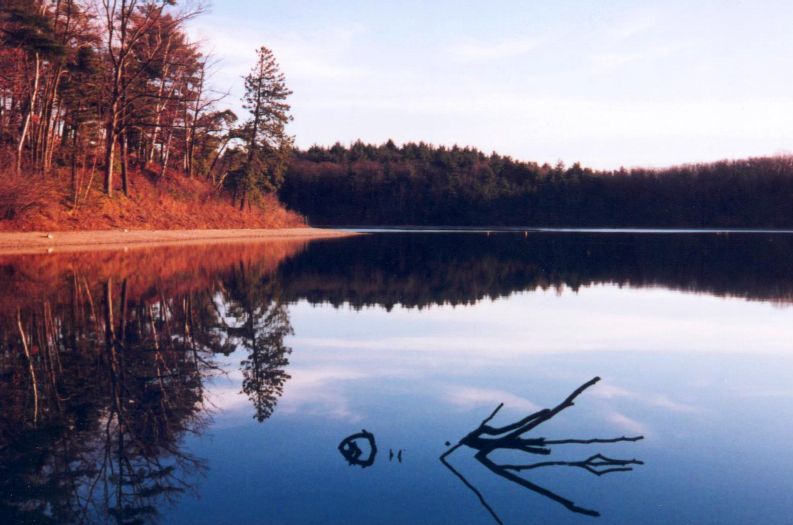
I was on my way back from getting my wrist X-rayed, so naturally, I was not in the best of moods. Driving back from Leesport, my GPS took me a way I had never gone before, which helped me come across one of the biggest, most BEAUTIFUL lakes I have ever seen in my life. I don't know what the lake is called, or even what town it is in; somewhere between Leesport and Kutztown is all I know. Spontaneously, I decided to pull over. The mere beauty of this place I was driving through pulled me in; something inside of me insisted I explore. I parked my car, and then simply sat on the edge of the water, literally for hours. I had nothing else to do that day, no homework, or meetings to be at; nothing to worry about...for once. As I sat, I looked around me, and I think for the first time in my life, REALLY appreciated nature, and what this earth has to offer us. For the first time, I wasn't sitting there thinking about what I had to do later, or if there were bugs crawling near me...I was just content. And that...was an amazing feeling.

Sunday, September 25, 2011

The common denominator.

Talk about a man who inspires you! After reading The Art of Seeing, by John Burroughs I felt like a completely refreshed, renewed person. Every word he spilled out of the page was so beautifully written,  and put together.

To be more specific, there were some quotes I pulled out of his work which really hit home with me more than the others. On page 146, the first page of his piece, he says, "The secret, no doubt, is love of the sport...what we love to do, that we do well. To know is not all; it is only half. To love is the other half". AMAZING. I feel like Burroughs hit it right on the head here. This is something that I have been struggling with a lot lately. Being as I am going into the field of education, in hopes of one day being a middle school english teacher, I hear a lot about how much the job market is suffering, and how I'm going to have a terribly hard time finding work once I graduate. While, yes, this may be the case, I have a lot of peers who are contemplating switching their major because of this job issue. I can't help but think that is a mistake. "The secret, no doubt, is the love of the sport". Teaching students, in this case, is the sport that I love. I can't imagine myself pursuing a career in anything BUT teaching. Taking what Burrough's said, and twisting it around a little bit, I feel like if you love what you do, and are truly passionate about it, you will be successful and do it well. He flat out says that half of "the secret" is to love. If we love what we do, we will figure the logistics out along the way.

Another line of this piece that I really connected with is on page 147 where Burrough's states, "Love is the measure of life; only so far as we love do we really live".
To a point, this quote also lines up with the previous one I discussed, with the common theme being love. "Only so far as we love do we really life". That may be one of the most beautiful sayings I have ever read. Without love we are nothing, we can't really live and experience life to the fullest without loving every minute along the way. If we don't love our "sport", love the nature around us, love our families, or friends...what are we really doing here in life?

Love is the common denominator.

Wednesday, September 14, 2011

Experiencing Life.

"I mean that they should not play life, or study it merely, while the community supports them at this expensive game, but earnestly live it from beginning to end". I'm not a huge Thoreau fan to be honest with you. I find his book, Walden to be a tad dry. Possibly also a tad, dare I say, boring? However, I feel like there is always SOMETHING a person can pick out of even their least favorite of books which appeals to them. For me? I have been, and always will be a quote girl.

I love a good quote more than anything else in this entire world (Okay, that may be a bit of an exaggeration, but I REALLY love quotes). It seems like no matter what you're going through in life, finding the perfect quote to explain your situation can somehow make things a tad better.

After reading Walden, I was able to find a couple quotes which really stuck out to me, but for now we'll just stick with the one above.  The part of this specific line which I enjoyed the most was the ending portion, "...earnestly live if from beginning to end". That may be one of the most beautiful lines I have ever heard. I have to reiterate, I really do think Thoreau was a tad crazy for sending himself into "isolation" for so long, however some of the ideas that he left Walden Pond with are extremely inspiring.

I feel like I can relate to Thoreau on the smallest level here. It took him going out into the woods, alone, for him to be reminded of this idea that we can't simply just study life, or learn about life, or watch others live their lives. We have to earnestly LIVE our lives. From beginning to end. Before going out into the woods for out Nature experiment in class, I had gotten so caught up in the daily stresses of life without even realizing it. I have 2 jobs, while also being a full time student. I love being busy, but I don't think I was really loving living my life. Much like Thoreau, it took going into the woods, by myself to remind me to slow down. I needed to stop living my life through text books, cell phones, computers, and work.

Truly living is doing things like throwing yourself out in the middle of nature; giving yourself a chance to EXPERIENCE the world around you rather than just talking about it in a classroom. At times, it can be hard to remember that "the way" we live really does impact how we function as people, and I feel like if we all could realize this, there would be much happier people in the world.